

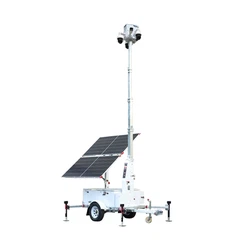
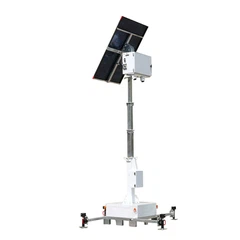
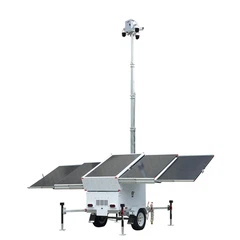

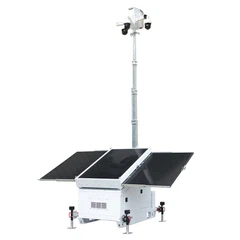


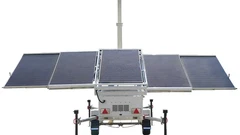


AI Surveillance Trailer: Real-Time Threat Detection for Off-Grid Security

For a temporary or remote security site, installing cameras is often the easy part. The bigger questions are usually more practical: where will the cameras get power, how will the video be transmitted, how high should they be mounted, and what happens when nobody is watching the screen?
This is where mobile surveillance trailers are useful.
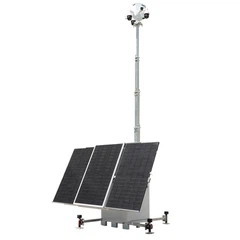
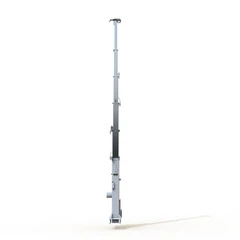
A trailer can bring the camera mast, solar power, battery storage and network equipment to the site as one system. When AI-enabled cameras or video analytics are added, the same setup can also help operators pick out events that need attention instead of relying only on continuous recording.
For construction sites, equipment yards, parking areas and other locations without permanent CCTV infrastructure, this can be a much more practical way to deploy surveillance.
What Makes a Surveillance Trailer "AI-Enabled"?
The trailer itself does not necessarily perform the AI analysis.
In many projects, the analytics are already built into the camera, NVR or video management system. The trailer's job is to give that equipment a reliable platform to work from.
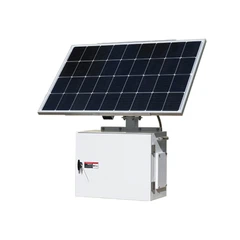
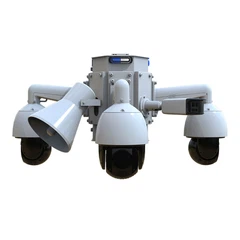
For example, a typical mobile setup may have one or more PTZ or fixed cameras on the mast, a PoE switch and router inside the CCTV box, batteries underneath the trailer and solar panels supplying the daily energy demand.
If the selected cameras support analytics, they may be able to distinguish people from vehicles, detect someone crossing a defined line, or send an alert when a person stays inside a restricted area for too long.
More advanced cameras and software can offer additional functions, but these vary a lot between manufacturers. This is why we normally look at the customer's camera specification first rather than treating "AI surveillance" as one fixed feature.
What Can the System Actually Detect?
For most commercial security projects, the useful functions are relatively straightforward.
A construction company may want an alert when somebody enters the site after working hours. An equipment yard may want to know when a person approaches a storage area. A parking operator may be more interested in separating vehicle events from normal pedestrian movement.
Depending on the cameras and software being used, common functions can include:
- human and vehicle detection
- intrusion or line-crossing alerts
- loitering detection
- perimeter monitoring
- vehicle classification
- unusual movement or activity
Other functions, such as license plate recognition, thermal analytics, fire or smoke detection and weapon-related detection, are available from some camera or software suppliers.
The important point is that these are camera and analytics capabilities. A surveillance trailer makes them easier to deploy in places where fixed power, network cabling or permanent camera poles are not available.
What Happens After an Alert?
Detection is only useful if somebody can act on it.
Take a simple after-hours intrusion as an example. A person enters a predefined area and the camera generates an event. Instead of asking an operator to notice the movement among hours of live video, the system can send the relevant footage or notification directly to the monitoring team.
The operator can then check what actually happened.
If it is a genuine security event, the response may be as simple as speaking through an IP speaker, activating a warning light, or contacting the person responsible for the site. For higher-risk situations, the monitoring company can follow its normal escalation procedure and contact guards or local authorities.
So in practice, the workflow is still:
Detect → Verify → Deter or Alert → Escalate
AI helps narrow down what deserves attention. The final decision remains with the person monitoring the system.

Frequently Asked Questions
Can an AI surveillance trailer detect weapons?
Some AI camera and analytics systems support weapon-related detection, but the actual capability depends on the selected camera and software.
Can I use my own cameras with a BIGLUX surveillance trailer?
Yes. BIGLUX trailers can be configured to work with different PTZ, fixed, thermal, and AI-enabled cameras.
How long can a solar surveillance trailer operate without sunlight?
It depends on the battery capacity and total equipment load. BIGLUX can calculate the expected backup time based on your camera system and deployment location.