

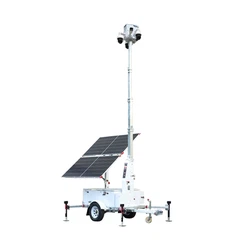
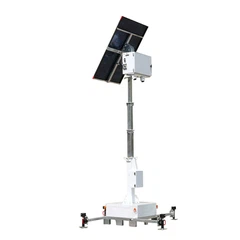
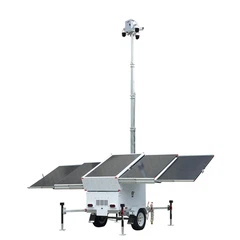

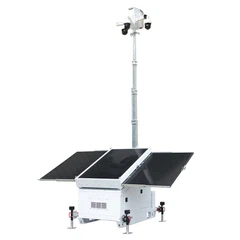
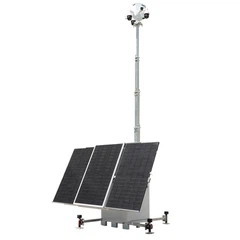
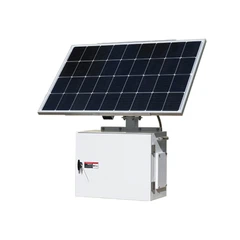
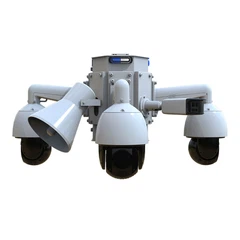


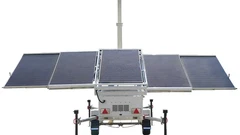


With the acceleration of global energy transition, solar surveillance and lighting trailers-versatile, low-carbon outdoor power solutions-are increasingly applied in construction sites, mining areas, emergency rescue, and other scenarios. However, significant differences in sunshine duration across regions (e.g., Arctic polar nights, tropical monsoon seasons, and extreme desert sunlight) pose severe challenges to equipment endurance and stability. This article analyzes the adaptive design and innovative strategies of such trailers by integrating state-of-the-art industry technologies and practical cases.
Core Technological Breakthroughs
Comprehensive Adaptation from Hardware to Algorithms

Intelligent Solar Tracking Systems
Traditional fixed solar panels see over 40% efficiency variation across latitudes. New-generation solar camera trailers use dual-axis tracking: photosensitive sensors monitor sun angles in real time, adjusting panel orientation for optimal capture. A patented design with electric push rods maintains >70% efficiency in polar regions with extreme day-night cycles, boosting Nordic winter daily output 1.8x over conventional systems.
Multi-Energy Complementary Energy Storage Systems
For regions with erratic solar conditions, solar surveillance security trailers integrate multi-source hybrid power supply systems. A typical solar camera trailer equips a 300W vertical-axis wind turbine (VAWT), triggered at wind speeds ≥2m/s to supplement solar energy. In tropical rainforests, when persistent rainfall reduces solar power, wind energy can bridge 30% of the energy gap. Additionally, LFP batteries (e.g., 200Ah capacity) operate across a broad temperature range of -40°C to 60°C, with only 15% capacity loss in low-temperature environments.


AI-Powered Energy Management Algorithms
Intelligent control systems adaptively optimize charging/discharging strategies by processing real-time meteorological data, battery health, and power requirements. During extreme desert sunlight, the system prioritizes rapid battery charging; in polar night conditions, it minimizes non-critical device power consumption via standby mode. Case studies demonstrate this algorithm enhances mobile CCTV trailer operational endurance by 40% in low-sunlight regions.
Scenario-Specific Solutions
Adaptation to Extreme Climates from Polar Cold to Tropical Heat
High-Latitude Regions: Cold Resistance and Long Endurance Design
Anti-Reflective Coating for Solar Panels: Nanometric anti-reflective films enhance light absorption by 30% in snow-covered reflective terrains.
Heating & Thermal Insulation Technology: PTC heating modules in battery compartments initiate automatically at sub -20°C to preserve electrolyte mobility.
Low-Power Devices: LED lights employ smart dimming, lowering brightness to 50% overnight to prolong lighting duration.
Tropical Rainy Regions: Heat Dissipation and Waterproofing Optimization
Auto-Cleaning Solar Panels: Water-Repellent Coatings and Ultrasonic Cleaning Technology enable rainwater to perform Dust Removal, ensuring Consistent Energy Output.
Battery Temperature Control: Liquid Cooling Systems maintain battery temperatures below 40°C, preventing Capacity Degradation caused by Excessive Heat.
IP67 Waterproof Rating: Hermetically Sealed Enclosures for Power Distribution Units and Surveillance Cameras withstand Heavy Rainfall.
High-Radiation Desert Regions: High-Temperature and Dust Resistance
High-Temperature Tolerant Solar Panels: EVA films and tempered glass with thermal resilience sustain 90% energy conversion efficiency at 70°C.
Dust Mitigation Design: Angled solar panel mounting frames reduce sand accumulation; multi-layered air vent filters prevent internal solar trailer dust buildup.
Typical Cases
Application Validation in Global Extreme Environments
Antarctic Research Stations
The "Dongda Polar Energy 2.0" system deployed at China's Kunlun Station in Antarctica utilizes multi-axis solar arrays and a digital twin platform, providing 50% energy supplementation during the polar day and reducing diesel generator reliance. It also collected 400 hours of extreme daylight irradiance data, offering critical parameters for polar solar energy applications.

Southeast Asian Tropical Rainforests
A mining company in Indonesia deployed solar-powered light trailers equipped with 300W solar panels and 100Ah lithium batteries, featuring wind energy integration. During the rainy season, these mobile solar units achieve 72 hours of continuous power supply. The smart system adjusts camera capture intervals based on rainfall frequency to curtail energy consumption.

Sahara Desert, Africa
A petroleum project adopted heat-resistant surveillance trailers, with solar panels producing an average of 2.4kWh daily to meet monitoring and lighting demands. The trailers operated for three years failure-free, with dust mitigation design cutting maintenance costs by 60%.

Future Trends
Technological Integration and Ecosystem Collaboration
Perovskite Solar Technology
Next-gen Perovskite Solar Panels: With a theoretical conversion efficiency exceeding 30% and a thinness 1/100th of traditional silicon panels, these panels could boost power generation by 50% in the same area-ideal for space-limited scenarios.
IoT and Edge Computing
5G/BeiDou communication modules enable real-time data upload to cloud platforms, allowing adaptive strategy adjustments via weather prediction models. For example, the system can activate energy storage mode 24 hours ahead of forecasted storms.
Modular Design
Users can flexibly replace solar panels, batteries, and load devices based on regional needs-e.g., high-power panels for sunny areas or low-temperature-resistant batteries for polar regions.
Conclusion
Solar-Powered Security Trailers Drives The Low-carbon Economy
The regional adaptability of mobile solar surveillance cctv trailers represents the seamless integration of energy technology and scenario-specific demands. Through innovations in intelligent tracking, multi-energy complementarity, and AI management, these devices now operate stably in extreme environments ranging from -40°C to 60°C and sunshine durations of 3–24 hours. With the popularization of perovskite technology, IoT, and modular design, solar-powered trailers are poised to become a "standard configuration" for global outdoor energy supply, driving the low-carbon economy across diverse industries.