





How Starlink Powers HiSOLO
Imagine a construction site in a remote Canadian forest, a temporary music festival ground, or a disaster relief zone with no cellular signal. How do you ensure continuous, real-time security monitoring? The answer lies in a powerful fusion of two cutting-edge technologies: the mobile solar-powered surveillance trailer HiSOLO and SpaceX's Starlink satellite internet. This combination is revolutionizing remote monitoring.
The Core Problem: Connectivity in the Boonies
Traditional mobile security units rely on cellular networks (4G/5G) for data transmission. This creates a critical vulnerability: no signal, no live footage. In vast, undeveloped, or disaster-struck areas, cellular coverage is often nonexistent or destroyed. This is where satellite communication becomes essential, and Starlink changes the game.
Enter Starlink: The Game-Changing Link
Starlink is a constellation of thousands of low-earth orbit (LEO) satellites providing high-speed, low-latency internet across the globe. Unlike traditional geostationary satellites, LEO satellites offer faster data speeds (50-200 Mbps) and much lower delay, crucial for live video streaming. Its key advantages for mobile trailers are:
Near-Global Coverage: Provides reliable service in polar, maritime, and deeply rural regions.
Rapid Deployment: The user terminal can auto-align and be online in minutes.
High Bandwidth: Easily supports multiple high-definition camera feeds streaming simultaneously.
The Perfect Match: HiSOLO + Starlink
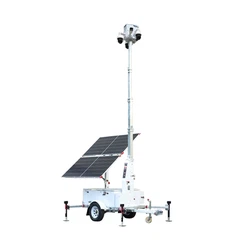
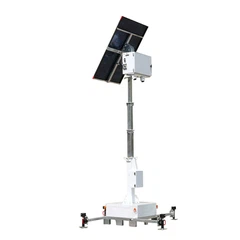
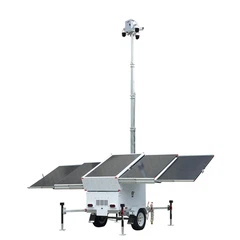
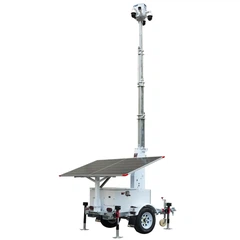
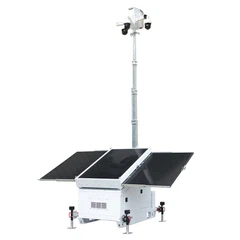
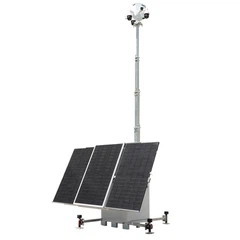
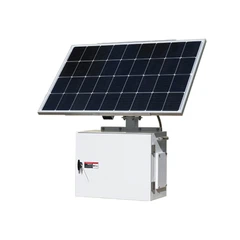
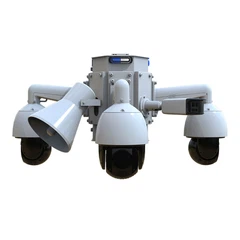
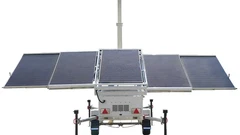
HiSOLO trailer is a self-contained unit with solar panels, batteries, cameras, and a communication system. Integrating Starlink creates the ultimate autonomous sentinel.
1. Technical Integration: How It Works
Power Synergy: Starlink's compact terminal consumes ~50-100W, which fits seamlessly into the HiSOLO trailer's existing solar power budget. A well-designed system powers cameras, computers, and the satellite terminal 24/7.
Network Hub: The Starlink terminal connects to an industrial router inside the trailer. This router creates a local network for the IP cameras and a Network Video Recorder (NVR), routing all video data through the satellite link.
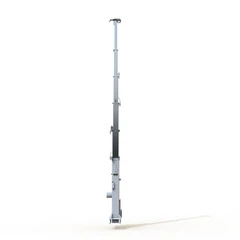
Ruggedized Design: For mobile use, the terminal is often mounted on a reinforced, vibration-damped mast or within a protective enclosure to withstand travel and harsh weather.

2. The "Killer App": Truly Off-Grid, Always-Online Surveillance
This integration solves the core challenges:
Location Independence: Deploy anywhere with a clear view of the sky-no need for existing infrastructure.
Energy Independence: Solar power eliminates fuel runs for generators.
Real-Time Intelligence: Security personnel can monitor live feeds, receive motion alerts, and control Pan-Tilt-Zoom (PTZ) cameras from a central office thousands of miles away.
Rapid Scaling: Units can be dropped at multiple points across a large area (e.g., a wildfire perimeter) to create an instant security network.
Real-World Applications
Critical Infrastructure: Monitoring remote pipelines, mining sites, and electrical substations.
Border & Perimeter Security: Cost-effective, movable surveillance points for vast borders.
Disaster Response: Providing immediate security and situational awareness for emergency camps and affected areas where terrestrial networks are down.
Agriculture & Conservation: Theft prevention for farm equipment and remote wildlife/forest monitoring.
Construction & Events: High-security temporary setups for long-term projects or festivals.


Conclusion
The marriage of HiSOLO trailers and Starlink is more than a technical upgrade; it's a paradigm shift. It breaks the final chain tethering remote security to fixed infrastructure: connectivity. By combining renewable energy with space-based internet, this technology delivers persistent, intelligent surveillance anywhere on Earth, turning the most isolated location into a securely monitored asset. It is the definitive solution for a world that needs to watch over its farthest frontiers.