

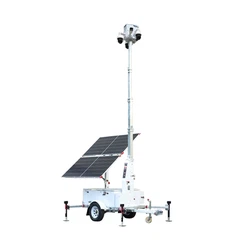
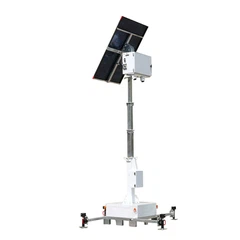
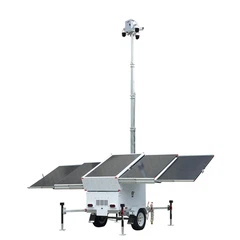

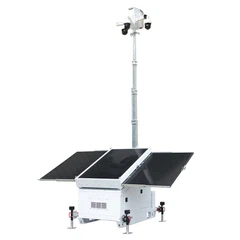


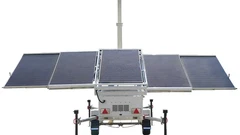


In the field of security monitoring, mobile surveillance trailers and stationary solar surveillance towers are two common outdoor monitoring solutions. Both rely on solar power technology for independent operation, but they differ significantly in deployment cost, flexibility, and applicable scenarios. This article analyzes their core differences from an industrial application perspective.

I. Deployment Cost Comparison: From Initial Investment to Full-cycle Maintenance
1. Initial Equipment Cost
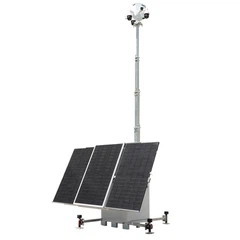
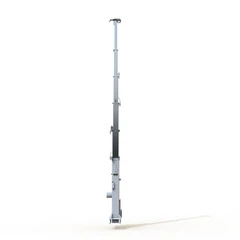
Mobile Surveillance Trailers: Integrated with trailer chassis, foldable solar panels, lifting masts, and multi-lens monitoring systems, the procurement cost typically ranges from USD 10,800–41,600. The advantage lies in their complete factory-installed functionality, eliminating the need for additional infrastructure.
Stationary Solar Surveillance Towers: Comprising concrete foundations, steel structure towers, large solar panel arrays, and high-end monitoring equipment, the upfront cost is higher, special expenses for foundation construction and tower hoisting are included.
2. Transportation and Installation Cost
Mobile solutions use trailer chassis for direct road transportation, with single-person positioning and low installation costs (5%-8% of equipment cost).
Fixed solutions require professional teams for foundation construction (1-2 weeks), special transport, and crane-assisted hoisting, with installation costs accounting for 20%-30% of equipment cost. In UNHCR's Pakistan project, installation costs reached 28% of total equipment value.
3. Full-cycle Maintenance Cost
Mobile equipment features modular design for easy component replacement, with annual maintenance costs around USD1,400–2,800. Battery replacements (e.g., lithium iron phosphate batteries, cost approximately USD 500/year.
Fixed Solar Surveillance Towers require professional aerial work for steel structure anti-corrosion (USD 3,000/3 years) and high-altitude equipment inspection (USD 1,500/time), with annual costs of USD 4,200–7,000. Structural maintenance for aging towers (e.g., weld reinforcement) adds USD 2,000 per incident.

II. Flexibility Differences: Scenario Adaptation and Rapid Response
1. Deployment Speed and Mobility
Mobile trailers achieve "plug-and-play" operation, with monitoring coverage available within 2 hours, ideal for dynamic scenarios like temporary events, construction sites, and disaster relief. The State Grid project completed deployment in 2 hours for spring maintenance monitoring.
Fixed Solar Surveillance Towers take 3-4 weeks from foundation to commissioning, difficult to relocate once installed. For border security projects, relocation costs can reach 40% of equipment value.
2. Environmental Adaptability
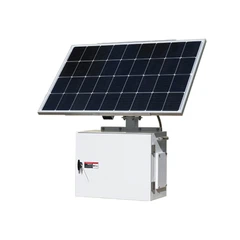
Trailers use adjustable outriggers for stable deployment on slopes and muddy terrain, with manually adjustable solar panels for optimal power generation. Biglux's solar system supports ±30° angle adjustment.
Fixed Solar Surveillance Towers require solid foundations, with additional reinforcement in soft soil or seismic areas. Their 8-15m height provides wide coverage for open areas, such as 500m radius in forest fire prevention.
3. Functional Configuration Adjustment
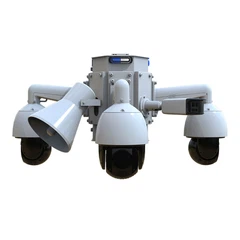
Mobile devices support quick replacement of monitoring modules (infrared, thermal imaging). HIKVISION's cameras allow remote mode switching via mobile app.
Fixed solutions are hard to modify after installation. Upgrades (e.g., lens replacement) require aerial work costing USD 1,000 and 2-3 days of downtime.
III. Application Scenarios and Selection Recommendations
Suitable for Mobile Surveillance Trailers:
Short-term projects (within 3 months): E.g., railway segment monitoring, with annual rental costs (USD 10,000) 60% lower than fixed alternatives.
Temporary events (concerts, sports): E.g., a 2025 concert used 3 units at USD 45,000 total, saving 60% vs. Fixed Solar Surveillance Towers.
Emergency command centers: Deployable within 2 hours to disaster zones.
Multi-point monitoring: Relocatable weekly for highway construction.
Suitable for Stationary Solar Surveillance Towers:
Long-term regional security (borders, coastlines): E.g., a border project with 10 units covering 20km at USD 50,000/year.
Large park perimeters (airports, industrial zones): E.g., an airport project with 8m towers and thermal imaging for 300m night vision.
Ecological protection (nature reserves, forest fire prevention): E.g., a nature reserve project with 15m towers and <5% false alarm rate.
Urban high-point surveillance: E.g., a city project with 12m towers covering 3km² commercial areas.

Conclusion
Mobile surveillance trailers and fixed solar surveillance towers represent two technical routes of "flexible mobility" and "stable long-term operation".
The former excels in rapid deployment and low maintenance costs for dynamic, short-term needs, while the latter offers high reliability and wide coverage for long-term fixed scenarios.
Users should select based on project duration, geographical environment, budget, and monitoring precision. With the integration of new energy and smart monitoring technologies, their technical boundaries are continuously optimizing, providing more precise solutions for diverse security needs.