

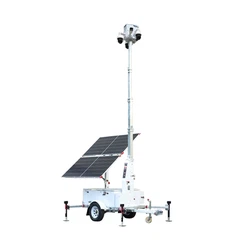
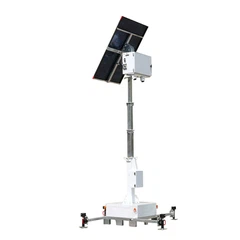
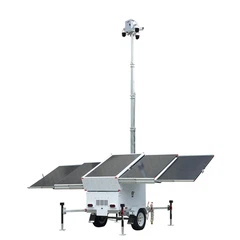

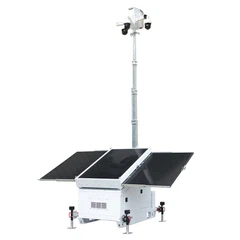
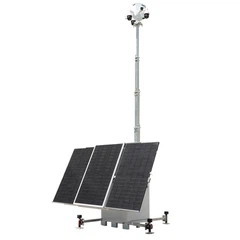


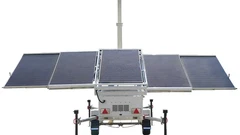


Introduction: Applications and Core Advantages of Mobile Solar Light Towers
In scenarios like emergency lighting, construction sites, mining operations, parking lots, and large-scale events, mobile solar light trailers have emerged as the top choice for energy-efficient lighting, thanks to their fuel-free, easy-to-deploy, and sustainable features.
With a crowded market of products, how do you select the optimal configuration for your needs? This guide breaks down four key elements-lighting performance, runtime requirements, energy systems, and structural design-to help you make an informed decision.
Ⅰ. Lighting Selection: Balancing Brightness, Power Consumption, and Lifespan
The choice of LED lighting is pivotal for both illumination quality and energy efficiency in light towers.

Brightness Requirements: From Lumen (Lm) to Real-World Adaptation
►Traditional lights (e.g., high-pressure sodium lamps) are bright but energy-guzzling and short-lived. LED lights, with their "high luminous efficiency and low power consumption," are the preferred option-using just 1/3 to 1/2 the energy of traditional lights for the same brightness, with a lifespan exceeding 50,000 hours.
►Case Example: For 90,000 lumens (Lm) of illumination-ideal for large venues like football fields or parking lots-500W or 600W LED floodlights/spotlights deliver uniform lighting while minimizing energy waste.
Light Type: Floodlights vs. Spotlights, Tailored to Your Needs
►Floodlights (beam angle >120°): Perfect for wide-area diffused lighting (e.g., construction sites, parking lots).
►Spotlights (beam angle 30°–60°): Designed for long-distance, precise projection (e.g., high-rise perimeters, mining sites).

Ⅱ. Daily Operating Hours: Defining the Energy System's "Runtime Baseline"
Runtime requirements vary widely by application:
①Temporary events (exhibitions, outdoor sports): Typically 10–12 hours/day of stable nighttime lighting.
②Construction sites: Part-time use, e.g., 6–8 hours/night, balancing efficiency and energy savings.
③Emergency scenarios: Require 72+ hours of backup runtime to withstand extreme weather.
Calculation Formula:
①Daily energy consumption (kWh) = Light power (kW) × Operating hours
②Example: A 600W light running for 10 hours uses 6kWh daily.
Ⅲ. Solar System Design: Matching Sunlight Conditions and Power Demand
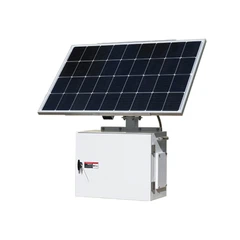
Solar panels and batteries are the "energy core" of light towers, requiring customization based on local sunlight resources and load requirements.

Solar Panel Power: The First Step in Harnessing Solar Energy
►Key specs: Peak wattage (W) and conversion efficiency. In sun-rich regions like Qatar (average 5kWh/m²/day), a 1000W solar panel generates ~5kWh daily.
►Configuration Tip: For 6kWh daily demand (e.g., 600W light × 10 hours), use 3×435W panels (total 1305W) to ensure stable charging even in cloudy conditions.

Batteries: The "Capacity Code" for Energy Storage
►Types:GEL batteries: Cost-effective for standard use, with 500–800 charge cycles. Lithium batteries (e.g., LiFePO4): Compact, high-capacity, and long-life (2000+ cycles), ideal for extreme temperatures or high runtime needs.
►Capacity Calculation: Allow 20%–30% buffer to avoid deep discharge. Example: 6kWh daily demand → 8–10kWh battery pack.

Controllers & Inverters: The "Smart Brain" for Efficiency Optimization
►MPPT controllers: Boost energy conversion by 30% compared to traditional PWM controllers, especially in variable weather.
►Inverters: Ensure stable DC-to-AC power conversion, sized to match light power (e.g., 800W+ inverter for a 600W light).

Extreme Weather Solutions
►High-latitude/winter regions: Increase panel wattage (20%–30%) and battery capacity.
►Frequent rain/clouds: Add a backup generator + AC charger for "solar+grid/fuel" hybrid power, ensuring 72+ hours of runtime.
Ⅳ. Mast Height and Structure: Balancing Coverage and Stability
Height Selection: From Lighting Radius to Scenario Fit
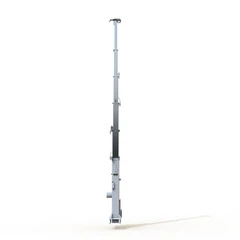
►7m telescopic masts: Pair with 400–600W lights for 50–80m radius coverage, suitable for mid-sized sites.
►10m+ telescopic masts: Combine with high-power lights (1000W+) for large open-pit mines, airport runways, or other long-distance lighting needs.
Structural Design: Durability Meets Portability
►Materials: Galvanized steel or aluminum masts with 10+ wind resistance (12+ for coastal areas).
►Lifting Mechanisms: Electric telescopic masts (one-touch operation) vs. manual hydraulic (ideal for off-grid sites).
►Trailer Chassis: All-terrain tires and shock-absorbing suspensions, like BIGLUX's patented anti-tilt design, ensure stability during transport.

Ⅴ.Conclusion

Trust Experience For Professional Solutions
Optimal mobile solar light tower configuration requires deep understanding of both application needs and technical implementation. BIGLUX, with a track record of delivering 600+ customized units for the Qatar World Cup parking lots, has proven its reliability across 40+ countries-from extreme cold to high-temperature environments-over a decade of industry expertise.
Choosing a partner with global project experience minimizes configuration risks and enhances deployment efficiency. BIGLUX specializes in mobile solar solutions, leveraging real-world insights to tailor systems for any scenario-temporary emergencies or permanent installations.
Ready to find your perfect fit? Contact BIGLUX today to unlock a customized mobile solar light trailer solution backed by technical excellence and proven experience.