

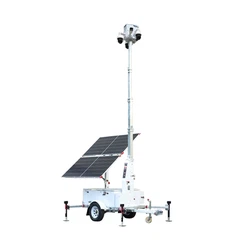
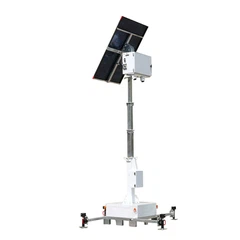
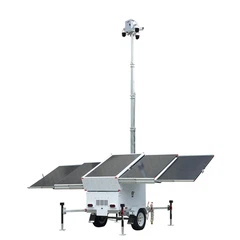

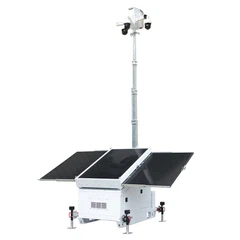


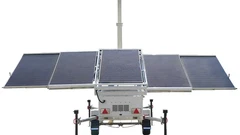


Solar-powered surveillance towers are becoming a core solution for reducing safety costs on construction sites due to their off-grid power supply, flexible deployment, and intelligent integration capabilities. According to data from the National Insurance Crime Bureau, construction sites suffer over $1 billion in annual losses from equipment theft and accidents, while traditional security systems struggle to provide comprehensive coverage due to complex wiring and high maintenance costs. This article combines technological trends and real-world case studies to analyze how solar surveillance towers achieve efficient safety management through innovation and cost optimization.

I. Cost Advantages of Solar-Powered Surveillance Towers
1.Initial Investment vs. Long-Term Operational Costs
- Traditional Solutions: Require cable installation, transformers, and backup generators, with per-unit deployment costs ranging from $3000 to $5000. Maintenance expenses account for over 20% of annual budgets.
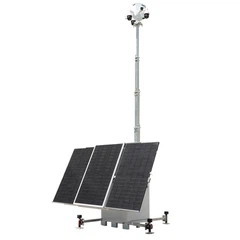
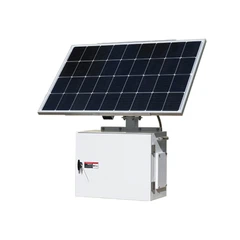
- Solar Surveillance Towers: For example, BIGLUX mobile surveillance trailers integrate solar panels, batteries, and 4G/Wi-Fi modules, eliminating wiring and reducing installation time by 70%. Solar power cuts long-term electricity costs by 90%, with batteries lasting over 5 years.
2.Reduced Reliance on Manual Inspections
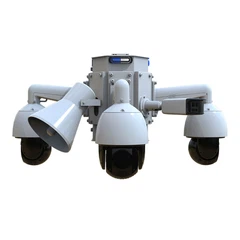
AI-powered detection (e.g., human/vehicle recognition, intrusion alerts) and remote monitoring reduce nighttime patrol staffing by 50%. A North American construction company cut monthly labor costs from 15,000 to 7,000 after deploying solar towers.
II. Key Technologies for Mitigating Safety Risks
1.Off-Grid Power Supply & Extreme Environment Adaptability
Equipped with 100Ah–400Ah lithium batteries and 80W–400W solar panels, these towers operate in temperatures ranging from -40℃ to 60℃. For instance, BIGLUX HISOLO models maintained uninterrupted monitoring for 7 days during sandstorms in a Middle Eastern construction site.
2.Smart Integration for Multi-Scenario Applications
- Crane Safety: Patent CN106444546A uses distance sensors and AI cameras to monitor blind spots around hooks, reducing crane operation accidents by 75%.
- Vehicle Management: Integrated GPS and fuel consumption tracking cut speeding violations by 60%.
- Environmental Monitoring: Dust and noise sensors trigger automatic sprinklers, avoiding fines (up to $10,000 per incident).
3.Scalability & Rapid Deployment
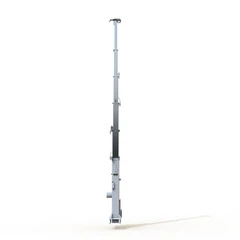
Mobile trailers with 3–6-meter telescopic masts deploy in under 2 hours, covering 5,000㎡. One smart construction project replaced 30 fixed cameras with 10 mobile towers, cutting equipment costs by 40%.
III. Case Studies & Cost-Benefit Analysis
Case 1: U.S. Texas Commercial Complex
- Need: Secure a 20-acre site against material theft and equipment damage.
- Solution: 8 solar towers with 4K cameras and thermal imaging.
- Results: Theft incidents dropped by 90%, insurance costs fell 25%, and annual savings reached $120,000.
Case 2: Shenzhen Smart Construction Pilot (China)
- Need: Real-time monitoring of cranes, deep foundations, and worker safety.
- Solution: Patent CN106444546A system with 5G transmission and BIM modeling.
- Results: Accident response time shortened from 30 minutes to 5 minutes, reducing project delays by 15%.
IV. Industry Trends & Future Innovations
1.Technology Integration
5G + Edge Computing: Reduces bandwidth costs by 50% through local data processing (e.g., Reolink Go Plus).
AI Predictive Maintenance: Cuts operational costs by 30% via battery health monitoring.
2.Policy Drivers
EU mandates require construction sites to adopt carbon-neutral monitoring systems by 2026, boosting solar tower adoption from 35% to 60%.
V. Procurement & Implementation Guidelines
1.Tailored Selection
- Small/Medium Sites: Prioritize 1080P resolution, local storage compatibility (e.g., MicroSD), and easy installation (e.g., magnetic mounts).
- Large Projects: Opt for 4K resolution, thermal imaging, and modular expansion (e.g., crane safety or environmental sensors).
- Harsh Climates: Choose IP66+ waterproofing and wide-temperature batteries (-30℃ to 60℃).
2.Compliance Checks
Ensure adherence to local data privacy laws (e.g., encrypted storage, facial recognition restrictions) and wireless frequency regulations.

Conclusion
Solar-powered surveillance towers transform construction site safety costs from "passive losses" to "proactive investments." By 2030, the global market for these systems is projected to exceed $12 billion, solidifying their role as critical infrastructure for smart construction. Companies should adopt cost-effective solutions aligned with AI and green energy advancements.
If you want to learn more about BIGLUX solar-powered surveillance towers, please feel free to contact our sales team.